MOHAI invites you to a powerful evening exploring how earthquakes have shaped Seattle’s past—and how they could define our future. Seattle sits in the shadow of seismic risk, from the massive Cascadia Subduction Zone to the deep tremors of the Nisqually Earthquake. But our community’s relationship with earthquakes goes back much further, woven into Indigenous knowledge, settlement patterns, and the very bricks that built our neighborhoods. Join a panel of experts as we connect history, science, and community resilience:
Pacific Northwest Seismic Network will share the latest science on Cascadia, Nisqually, and other earthquake scenarios that could shake our region.
Calvin Bray (Chehalis Tribe) will discuss “Early Warnings from Ancient Stories” — how Native myths and oral histories have long served as vital tools for earthquake awareness and preparedness.
Historic South Downtown will highlight the history and vulnerability of Pioneer Square and the Chinatown-International District, two of Seattle’s oldest neighborhoods most at risk in the next big quake.
City of Seattle will share what’s being done about Unreinforced Masonry (URM) buildings—their dangers in an earthquake, and the city’s steps to improve safety before disaster strikes.
This event will spark urgent conversations about memory, science, and preparedness. Together, we’ll look at how lessons from the past and present can help us build a safer future—before the ground moves again.
Where: Museum of History and Industry, 860 Terry Ave N, Seattle, WA 98109
When: Wednesday January 21, at 6:30 pm
History Café is produced as a partnership between HistoryLink and MOHAI. Support for this program is provided by the Hugh and Jane Ferguson Foundation.
Interpreters: Amie Pease & Emily Thiel
ASL Interpretation and CART captioning are available during the program. In addition, a limited number of Assistive Listening Devices are available upon request. For more accessibility support, email programs@mohai.org before the program.
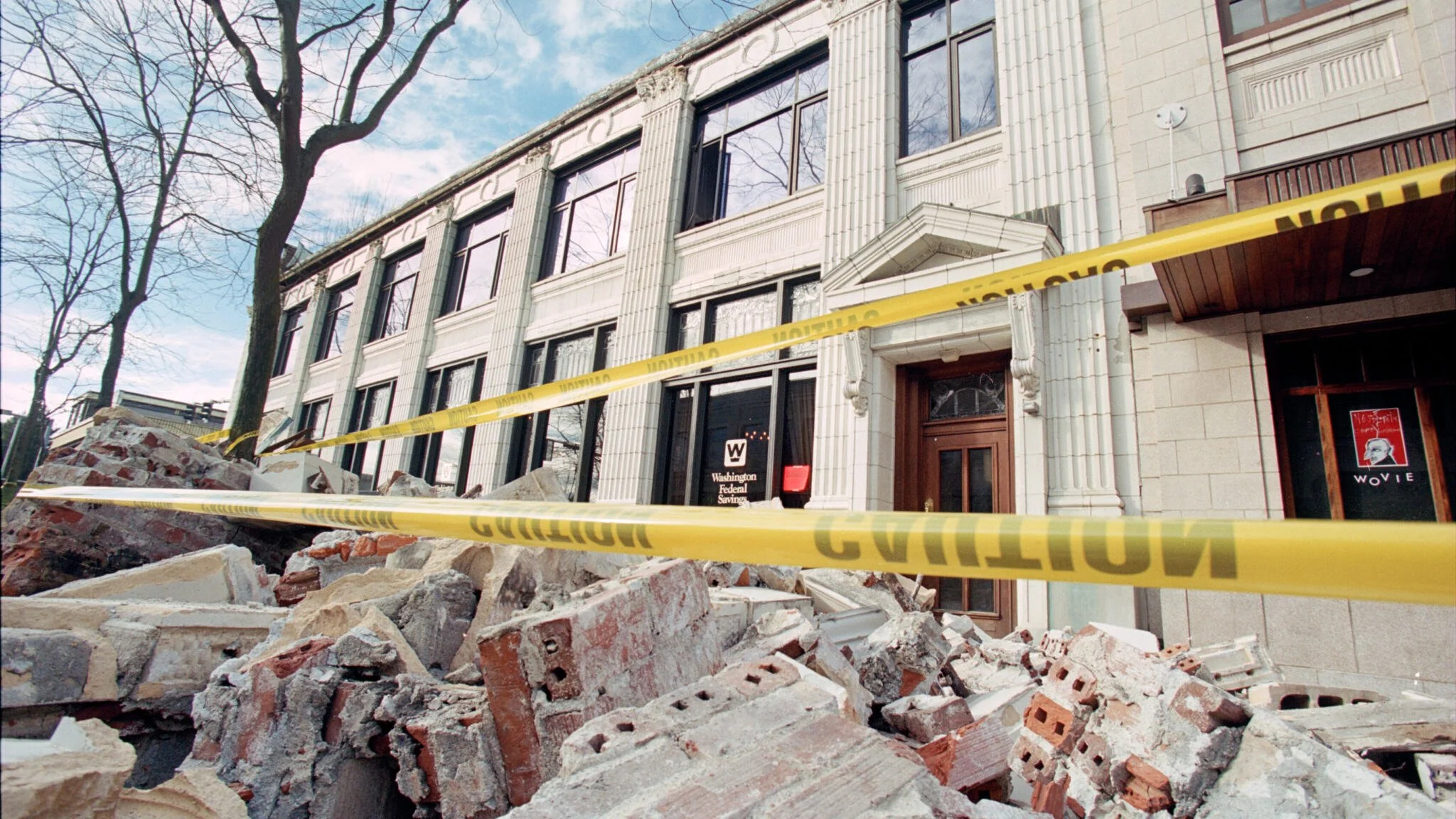
ID: A vintage color photograph of a white building with a sign on window “Washington Federal Savings”. In front of the building, there is a pile of rubble and bricks, and it is closed off with yellow caution tapes.